Beyond financial literacy: understanding why Italians don’t invest
Decode Future Scenarios
Financial Services
MEDVIDA Partners Italia
2026
CHALLENGE
The Italian savings market is marked by a persistent contradiction: financial information has never been more accessible, yet significant volumes of capital remain idle. The most common explanations (low financial literacy, product complexity, socio-economic instability) only tell part of the story. How do people actually make meaning of money? What behaviors, biases and influences are really at play?
SOLUTION
A research study on a panel of approximately 430 people, combined with data from institutional sources and principles drawn from behavioral finance, sociology and cultural anthropology. The project was developed through survey design, data analysis, and a series of working sessions with MEDVIDA Partners Italia and the CEOs of two of their partner networks to sharpen the key interpretive findings, presented at Salone del Risparmio 2026.
IMPACT
A distinctive positioning for MEDVIDA Partners Italia at Salone del Risparmio 2026, the largest event on the investment management industry in Italy. An interpretation of quantitative data that centers around human behavior and opens a broader conversation about the role of trust as the lever for unlocking paralyzed savings.

The approach: three levels of inquiry
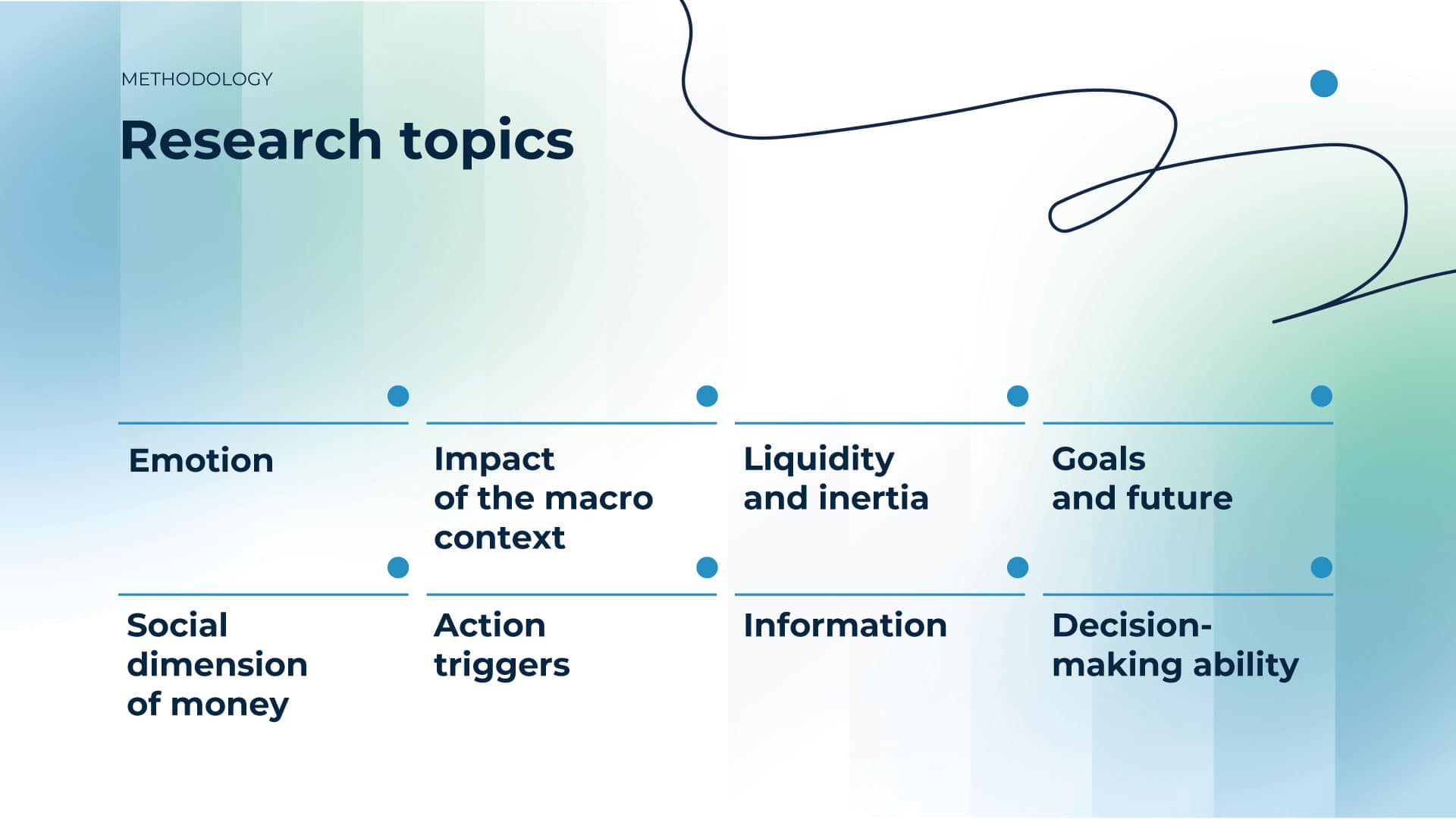
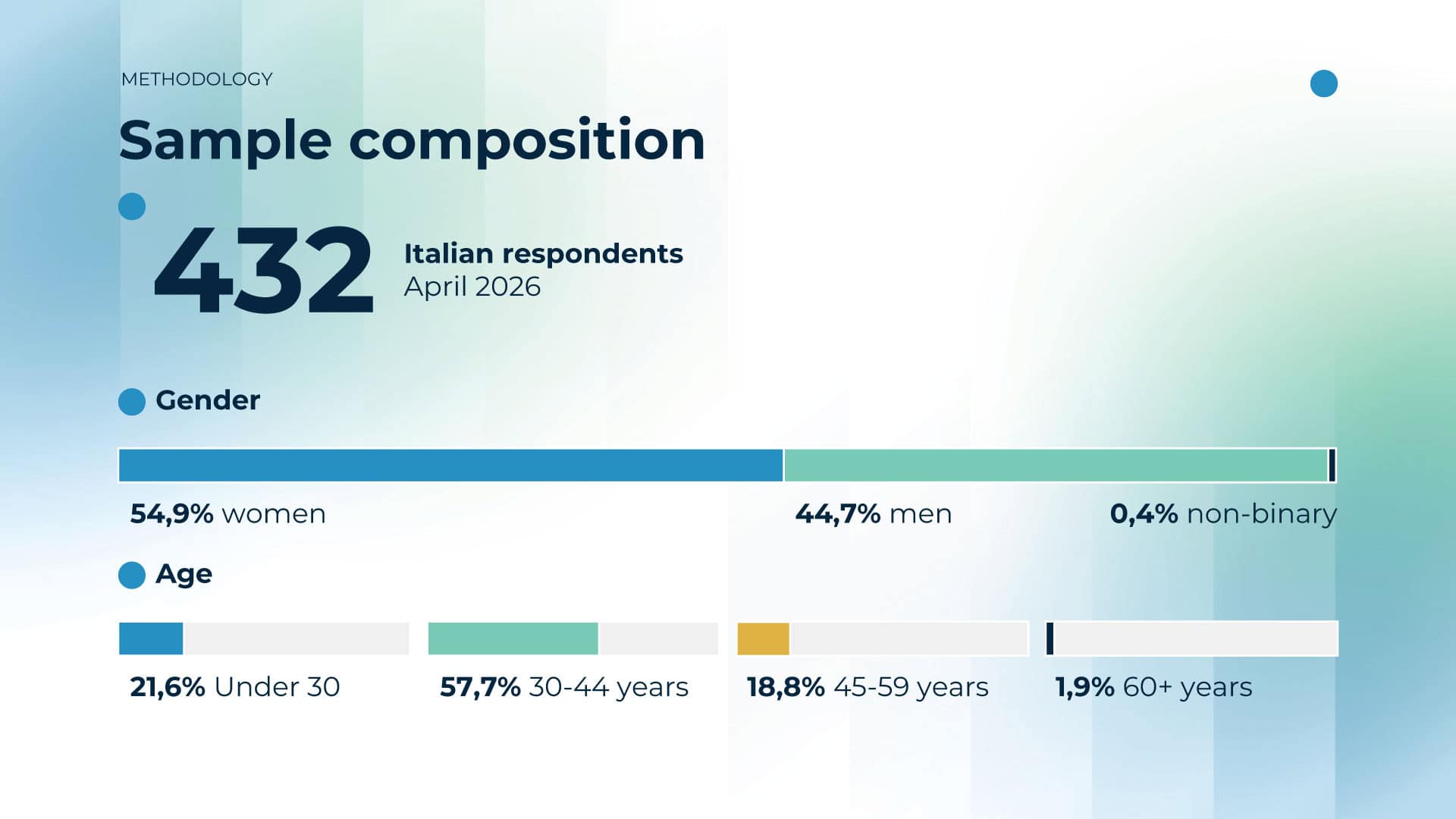
We designed the research to be personal, asking questions that dig into the deeper motivations behind people’s choices on a topic that is otherwise very pragmatic. The survey was designed to capture the emotional reactions people have to the idea of investing, the people they talk to about money, the impact of the current socioeconomic climate, the barriers behind inertia, and the triggers for action. The panel of approximately 430 respondents skews toward higher education levels, with the 30–44 age group as the largest cohort.
To strengthen the interpretation of the data, we drew on evidence from institutional sources, including CONSOB, Banca d’Italia, Osservatorio Edufin Pictet and OCF, alongside principles from behavioral finance (Kahneman, Thaler), economic sociology (Zelizer) and anthropological thinking (Mauss).
From survey data to cultural insight
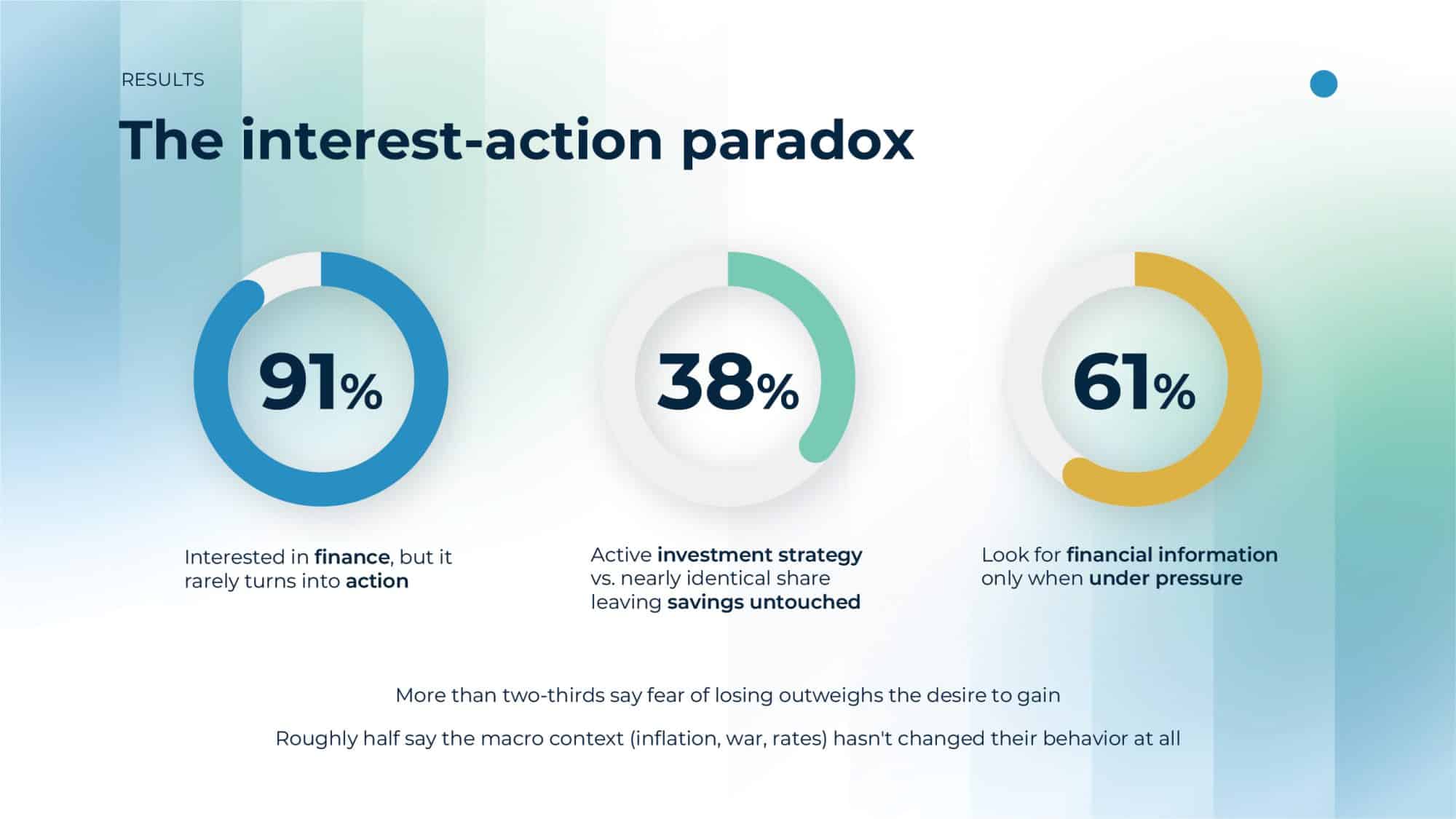
The first signal in the data is a paradox: interest in finance is nearly universal, 91% of Italians say they are interested in the topic (Osservatorio Edufin Pictet, 2025), but it rarely turns into action. Within the panel, 38% already have an active investment strategy, while a nearly identical share leave their savings untouched despite recognizing they should be put to work. More than a third use social media to gather financial information — yet only 3% say it actually shapes their decisions (CONSOB, 2024). Inside the panel, the same channels behave differently.
AI is used at nearly identical rates by both groups — 34% of those with an active strategy, 33% of those who remain inactive — and so is social media, at 39% versus 43%. Unlike AI and social media, the financial advisor is not used at comparable rates: consulted by roughly two thirds of those with an active strategy, against less than a third of those who remain inactive.
A study on Italian households using Bank of Italy microdata (Aristei & Gallo, University of Perugia, 2025) suggests one likely reason: it’s confidence in one’s own financial ability that shapes which channel people turn to, human or automated. The advisor may be structurally reaching people who already feel equipped to act, not the people most in need of being reached.
36% use social media as a source for financial information. 3% make decisions based on what they read there (CONSOB, 2024).
Social media shapes financial curiosity, but converting that curiosity into action takes a relationship people trust enough to act on, the one thing an algorithmic feed isn’t built to offer.
61% look for financial information only when under pressure, an imminent decision, a worrying headline.
Financial thinking activates around a concrete trigger, not on an ongoing basis. Designing for someone who plans ahead means designing for a minority.
17.7% of the panel already uses conversational AI tools to talk about money.
The appeal isn’t sophistication, it’s availability without an appointment and freedom from judgment: a signal of what traditional advice still doesn’t sufficiently offer.
The tendency to leave money untouched amid today’s uncertainty is rational and makes sense against the wider socio-political-economic context. In a country where interpersonal trust ranks among the lowest in Europe (Integrated Values Survey, 2022), and where almost all financial advisors work on a commission-based mandate (OCF, 2024), waiting is a coherent strategy. More than two thirds of Italians say that the fear of losing weighs more heavily on their financial decisions than the desire to gain (Osservatorio Edufin Pictet, 2025), and roughly half the panel states that the macro context – inflation, war, interest rates – has not changed their behavior at all: confirmation that inertia comes before external events and does not depend on them.
The finding that generated the richest discussion at the Salone concerns the family. 73.5% of the panel only discusses money within the family circle or with close friends, while the financial advisor comes third, at just under a third of respondents, as a channel people turn to for money conversations. Read through the lens of Zelizer’s economic sociology and Mauss’s anthropological thinking, this data point becomes more precise. The family is the primary institution of trust that manages meaning before it manages money. Saving “for the children”, “for the house”, “for security” are moral categories that run deeper than any financial calculation. The family’s mental accounts, as Thaler calls them, operate by their own rules and carry a deep structural resistance to outside intervention.
This evidence carries a productive and unresolved tension. The family is a meaningful anchor: it creates a shared sense of direction, reduces anxiety, and produces intergenerational continuity, but it also steers people toward conservative financial instruments, even among those who explicitly declare they want to do things differently. Six in ten respondents say they want to take a different approach from their parents, then go on to choose government bonds and real estate, the two instruments that have long dominated Italian portfolios, and the ones their parents’ generation most likely relied on. Financial behaviors pass from one generation to the next in ways that are deeply ingrained, operating beneath the level of conscious decision-making.
The 30–44 generation, the core of the panel, carries this tension in its most acute form: anxiety and confusion together account for over half of all first reactions to “investing” across the sample, a cohort this age group dominates by sheer weight of numbers. The fear of waiting for the “right moment” is not a generational trait on its own — it holds at roughly a quarter of respondents in every age bracket — but for this generation it collides with an actual deadline. Nationally, the same pressure lands on a wider group: by 2030, approximately €2,000 billion will be transferred by inheritance to Millennials and Gen Z broadly (AIPB), a generation that also shows a measurable competency gap. On questions assessing financial literacy, 18–34 year-olds answered correctly 66% of the time, against over 80% for those over 64 (CONSOB, 2024).

The questions that remain open
Almost half of the respondents identify “someone who explains without selling” as what would finally move them to invest, a person with no commercial interest in the answer they give, a figure that rises to 48% among under-30s, the most digitally native cohort. Separately, 17.7% of the panel already uses conversational AI tools to talk about money, read by this research as a signal of a need — anonymity, availability without an appointment, freedom from judgment — that traditional advice does not sufficiently meet.
Kinship works through obligation and closeness, anonymity works through their absence. This is the tension this research put in front of industry operators at Salone del Risparmio, in a panel discussion on the relational and cultural conditions that make a conscious financial decision possible. As Mauss argued, monetary exchange is never a purely economic transaction: it carries social obligation, expectation, and inheritance — which is why financial decisions cannot be separated from the relationships in which they are made. What this research points most clearly to is that managing money remains a matter of relationships. Despite the many channels and digital services that now allow people to do it alone and learn about the sector firsthand, most still seek human confrontation to understand how to move forward, and building trust remains the key to everything. What a trusted figure offers isn’t just reassurance: it’s what Thaler and Sunstein call choice architecture, not the elimination of complexity, but its translation into a decision someone can actually make. This is also the shift that requires the deepest cultural change, the figures and relational models capable of entering people’s circle of trust, before products, channels or technologies.
What such figures and relational models should actually look like is not yet settled, and this is exactly what the research leaves open for the industry to work through. How might the balance between human and technological support shift as someone moves through different moments in life, rather than staying fixed regardless of what each moment actually requires? How might we build trust that holds even after people realize no tool is ever truly neutral — only more or less transparent about whose interest it serves — so people feel confident enough to act?
73.5% only discuss money with family or close friends. The financial advisor comes third.
Before any advisor, platform, or institution enters the picture, the family already holds the conversation about money and, with it, most of the influence over what happens next.
60% want to invest differently from their parents, then choose government bonds and real estate, the tools that have dominated Italian portfolios for decades.
There is a structural gap between what people say and what they do. Intergenerational transmission of financial habits proves stronger than the intention to change.
47% want someone who explains without selling. This holds for 48% of under-30s too.
The most digitally native generation wants a relationship free of conflicts of interest, an advisor whose pay doesn’t depend on which product, policy, or plan they recommend.
Understanding why people save but don’t invest requires more than financial data, it demands a behavioral and cultural lens. At MAIZE, we bring together research design, strategic interpretation and storytelling to help organizations decode the behavioral and cultural forces behind complex decisions and turn those insights into more informed strategic decisions.