FRANÇOIS OR FRANCÉS?
The tale of an Occitan separatist
The quest to awaken a nation that never existed, armed only with the ghost of a forgotten language
Imagine the Alps on the border between Italy and France, depicted on a large, slightly worn map spread out on a wooden table in the middle of a bare room in a stone house, with a crackling fireplace and a small window on the opposite side to prevent too much heat from escaping. Outside, there are a few dozen houses, a few hundred inhabitants, and a bell tower. This is Val Varaita, in the province of Cuneo. The village is called Frassino, Frasso in Piedmontese, and Fraisse in a language that will later be identified as Occitan by the man sitting in that bare room, staring at the worn map and drawing lines on it with a pencil. It is 1965 or 1966, and Aldo Moro is Italy’s Prime Minister for the second time. In France, Charles de Gaulle is head of state at the Élysée Palace.
Isoglosses is the technical term for the lines that the man is drawing. They delineate areas of a territory that share a common linguistic feature. He chooses a word – he has written several in a notebook, which he keeps open on the wooden table – and connects the points where it is pronounced in the same way. The result is an undulating web of meanings and significances that cross the area like tides – the verbal forms that are the pronounceable tip of an iceberg of encounters, clashes, invasions, alliances, rivers or mountains that are hard to pass, rejections, fascinations, impositions, fashions, and coincidences. Just north of the Po River, fratello (brother) is pronounced fradel. A finger’s length to the south: fratel. A few centimeters further to the west: frel. Then frair, fraire. And finally, we are in France, where the man drawing isoglosses on the map in the bare room was born. He is not even forty years old. His name is François Fontan, while in Occitan it is Francés Fontan. He was the son of a railroad worker and a fallen noblewoman from Gascony. He began his political career at the age of fifteen as a monarchist, but later became an anarchist. He then joined Socialisme ou Barbarie, a party inspired by Trotsky. At the age of thirty, in 1959, he founded the PNO, the Occitan Nationalist Party, in Nice.
Now we must leave the bare room we have imagined and embrace the broader context. At the top of the Wikipedia entry on de Gaulle is one of his quotes: “There is a two-thousand-year-old pact between the greatness of France and the freedom of the world.” At the time, France’s greatness was also measured by its crumbling colonial empire. These were the years of independence for Vietnam, Laos, Cambodia, Morocco, Tunisia, Gabon, Chad, Ivory Coast, Benin, Guinea, Burkina Faso, Mauritania, Niger, Senegal, Mali, Cameroon, and so on. And there was a war, a massacre, that left its mark on public opinion more than any other: the Algerian War, from 1954 to 1962, in which between 300,000 and 1 million Algerians were killed and 3 million sent to internment camps, out of a total population of about 10 million. The FLN (Algerian National Liberation Front) claimed responsibility for a series of attacks on French soil: targeted assassinations, bombs in barracks, restaurants, and cafés.
The thinking that got François (or Francés) Fontan fired up — after his long and troubled political and romantic journey — was as straightforward as it was explosive: Is a general decolonization process underway? Great. Are oppressed peoples around the world gaining independence from France? Great. So it’s our turn, Occitans. I mean it. We know our enemy: Paris. But who are we? We are our language. And what are our borders? We need to find out.
François (Francés) had always loved to study. And the more he learned, the more he realized that his homeland, their homeland, was vast: stretching from the Alps to the Pyrenees, overlooking the ocean in Gascony, and extending into the heart of what they called France, all the way to Auvergne and Limousin. It is the region where Occitan (lenga d’òc) is spoken (or, rather, was spoken). For a people is the language it speaks (or spoke). And if some power forces them to speak a language that is not their own, they must rise up and rebel. It sounds naive, yet if you think about it, what did Italians have in common before unification, if not Italian (which few spoke)?

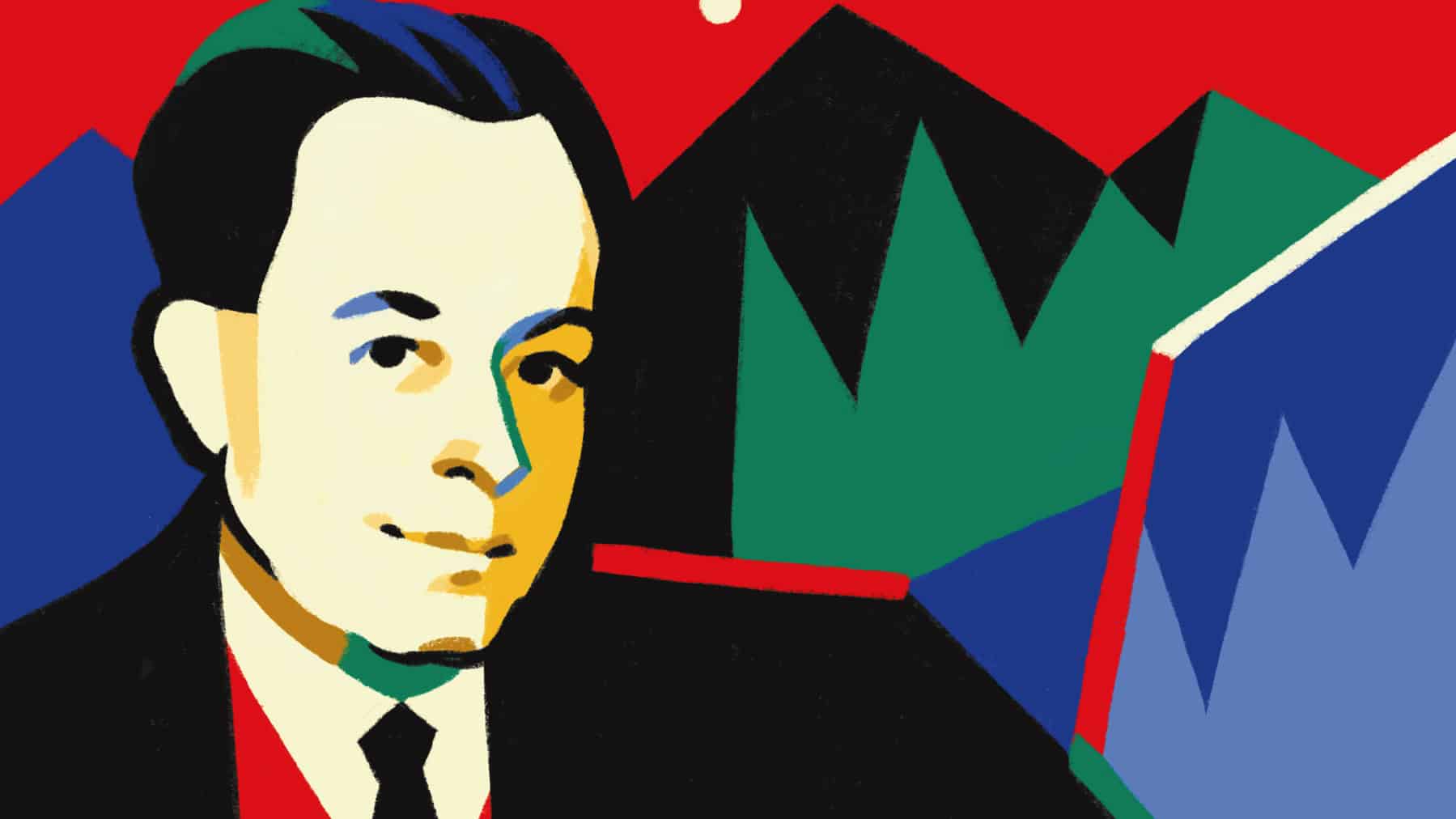
ILLUSTRATION by Marta Signori
The task that François (Francés) Fontan set himself was also naive: to awaken this nation that never existed, this forbidden homeland that spanned almost 200,000 kilometers. The French authorities took him seriously, accusing him of ideological and operational links with the terrorists of the Algerian National Liberation Front. Fontan ended up on trial. Realizing that he was in grave danger, he fled across the Alps and reached the Val Varaita, which was marked on maps as being in Italy, but which he knew was actually Occitania, still his homeland. He stopped in Frassino, Fraisse, which at that time had a little more than 800 inhabitants (today perhaps 200), and put his belongings and books in the stone house where we introduced him at the beginning of the story.
Everything has changed, but he continues to do what he has always done: study, be passionate, inspire passion. He began to wander from house to house. He is not a mountain man, that much is clear at first glance. He is a strange specimen, not one of them. An immigrant wandering in places that are increasingly depopulated; the plains with their cities and factories (Michelin in Cuneo, FIAT in Turin, etc.) are swallowing up all the young people from up there. He speaks to those who remain. He knows their language: to these people, he must seem like a magician. They had always been told that their language was a stigma to be torn off: it was not the Italian of school, of the law, of television; it was not even the Piedmontese of everyone else. It was the language of poverty; it did not even have a name. And now this refined and passionate intellectual tells them that it is called “Occitan”. That in a distant past it was the language of the most refined courts of Europe, of the powerful, of the poets (the Provençal poets) whom Dante Alighieri admired, imitated, and placed on the highest steps of Purgatory to converse with us in their language.
Everything has changed, but he continues to do what he has always done: study, be passionate, inspire passion. He began to wander from house to house. He is not a mountain man, that much is clear at first glance.
François (Francés) Fontan knew how to persuade. He was one of the founders of the MAO, the Occitan Autonomist Movement. Eight years ago, I got in my car and drove to these valleys to meet someone who had known him, someone who had been his follower, someone who had fought alongside him. I met several people. Some invited me into their homes and cooked me an Occitan meal.
Another gave me some MAO magazines from the 1970s that still smelled of tobacco. Others told me about the Buco di Viso, Pertús dóu Visol in Occitan, the first Alpine tunnel, seventy-five meters dug into the rock to speed up the journey between Crissolo and Ristolas, the first in Italy and the second in France, both in Occitan: it was opened twelve years before the discovery of America, in 1480. Someone else gave me an Occitan edition of The Little Prince, Lo principet. I also met the disappointed, the embittered, the scarred of that time. The serenely indifferent. And those who think that the bizarre history of Occitania is a good marketing tool for tourism.
François (Francés) Fontan died in Cuneo at the age of fifty. In the last years of his life, he worked on the development of a standardized Occitan language with a uniform grammar, pronunciation, and spelling. The proposal is known as the “Fontanian orthography,” but it never caught on due to the great fragmentation of what we call the Occitan language.