“I hope you’re all Republicans.”
These were Ronald Reagan’s famous words as he was being prepared for surgery after the assassination attempt. It was March 30, 1981. A gunman had just shot him in Washington, D.C., as he was leaving the Hilton Hotel — the same hotel where, on April 25, 2026, a gunman opened fire during the White House Correspondents’ Association dinner, forcing the evacuation of President Trump, J.D. Vance, and other senior officials. Reagan’s assailant was John W. Hinckley Jr. He fired seven shots from a .22-caliber revolver in just five seconds. One of the bullets ricocheted off the armored presidential limousine and struck Reagan under his left arm. The round punctured his lung and stopped just 25 millimeters from his heart, mere months after he had become the 40th president of the United States. Reagan removed his oxygen mask to deliver his witty line to the surgeons bustling around him as he lay on a stretcher. Before entering politics, he had been a Hollywood actor.
Though the surgery was long and delicate, the president survived and made a full recovery, though the experience likely shook him deeply. His wife, Nancy Reagan (née Nancy Davis), was arguably even more shaken. The two had met by chance two decades earlier. Nancy was also an actress. In 1949, at the height of the anti-communist hysteria led by Senator McCarthy, she discovered her name was on a blacklist of actors suspected of communist sympathies. She had apparently been confused with another actress of the same name. Desperate, she turned to Ronald Wilson Reagan, the fiercely anti-communist president of the Screen Actors Guild, who helped her clear her name. They were married three years later. Even before the shooting, Nancy Reagan had every reason to be anxious. Her husband had just stepped into one of the most dangerous jobs in the world. Of Reagan’s 38 unique predecessors, eight had died in office — roughly 20%. The odds were grim: entering the Oval Office was historically like turning over one of five facedown cards on a table, knowing one would seal your fate. When her husband finally emerged from the operating room, Nancy’s mind filled with images of a pair of piercing eyes, a flowing head of blonde hair, and a specific name: Joan Quigley.
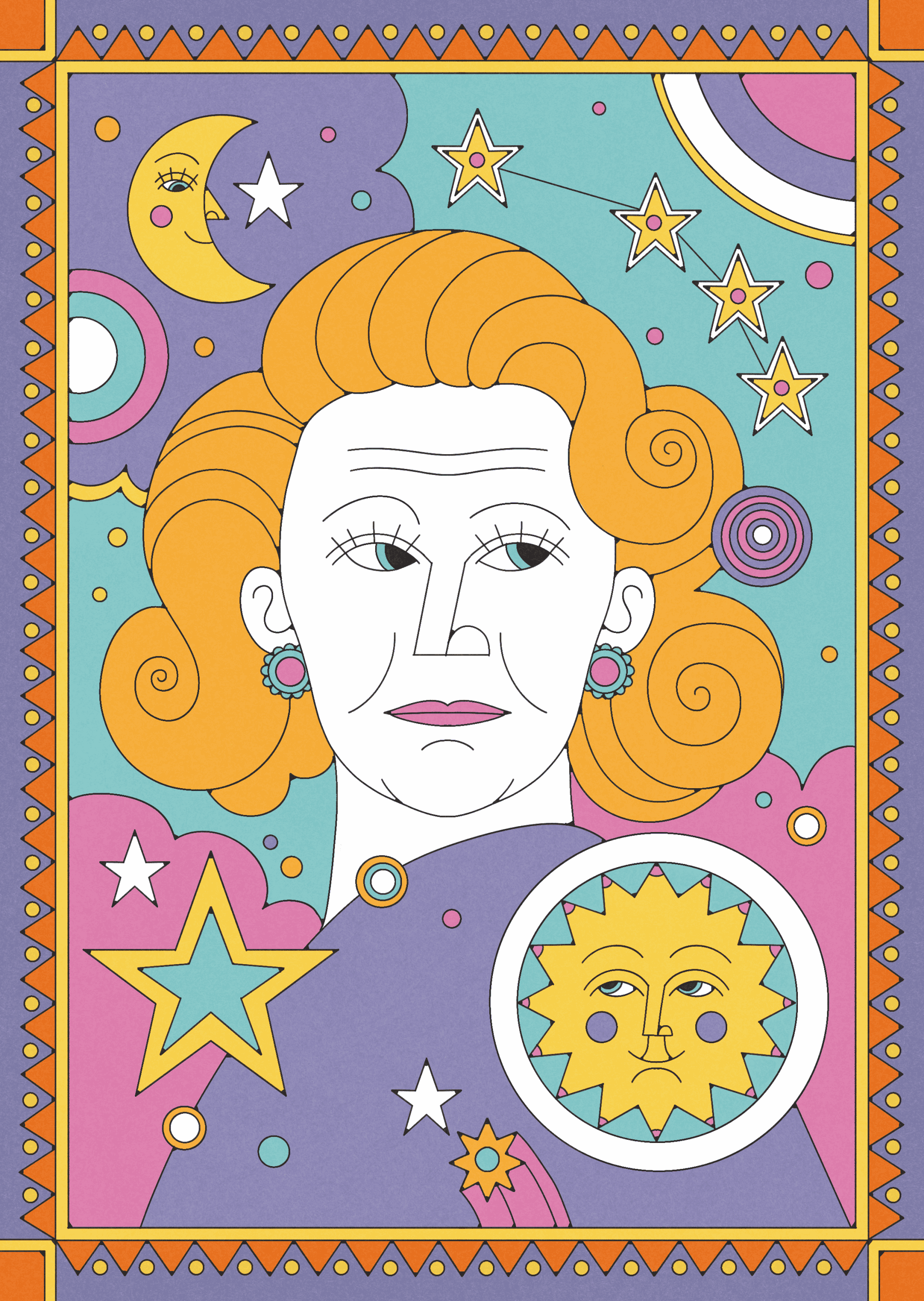
Quigley was a wealthy 54-year-old heiress — cultured, elegant, a fixture of San Francisco’s high society, and a frequent guest on television talk shows. She was an astrologer. Panicked and desperate to protect her husband, the first lady called Quigley with a blunt question: Could this assassination attempt have been predicted? Quigley essentially answered yes. She claimed that by cross-referencing the president’s birth chart with celestial transits, she could have identified March 30 as a day of profound, ominous danger. While helpful, such broad warnings weren’t enough; a President of the United States cannot simply take random days off.
ILLUSTRATION by Laura Bonanno
The analysis had to be flawless. When Quigley claimed she could track the alignment of the stars down to the exact minute, Nancy knew she had found her solution. With that promise, Joan Ceciel Quigley became the invisible hand behind the White House calendar. Whispers around the Oval Office multiplied alongside growing scheduling oddities. People began to notice the president’s unannounced, down-to-the-minute timing for meetings with staff, the press, and foreign leaders. Quigley was reportedly consulted on every scheduling decision: finding auspicious days for public appearances, inaugurations, trips, official visits, and private meetings, while red-flagging days when security needed to be maximized or public appearances entirely avoided.
The questions grew louder: Was the president of the world’s greatest power being manipulated by an astrologer? Or was he being manipulated by his wife, who was herself being manipulated by an astrologer? Could this be tolerated in the volatile climate of a Cold War, which could ignite at any moment? The boiling point was reached on February 27, 1987, when White House Chief of Staff Donald Regan resigned. In the months following his resignation, Donald devoted himself to writing a tell-all memoir titled For the Record: From Wall Street to Washington. An enterprising journalist read an advance copy, caught wind of the Joan Quigley angle, and on May 2, 1988, the Washington Post broke the story with the headline Astrologers Used by First Lady, Regan Book Says. The story instantly dominated NBC News and media nationwide. It was a massive national scandal; the ultimate presidential skeleton had been dragged out of the closet.
The next day, White House press secretary Marlin Fitzwater confirmed that Mrs. Reagan was indeed interested in astrology, noting that her interest had developed as a coping mechanism after the 1981 assassination attempt. In short, the administration framed it as the wife’s fault — a forgivable flaw born of human weakness. Hours later, the president himself addressed a group of reporters, declaring that none of his policy decisions had ever been influenced by astrology. When pressed on whether Quigley had altered his agenda, he deflected with signature humor: The answer was: “You know, I’m still looking for the guys who tell me what to do every day.” In 1989, at the end of her husband’s second term, Nancy Reagan published her own memoir, My Turn. “I was doing everything I could think of to protect my husband and keep him alive,” the former first lady wrote, defending her reliance on astrology as a way to overcome paralyzing fear and uncertainty.
The day of the assassination attempt, March 30, 1981, fell on a Monday. The Sun, Venus, and Mars were all in Aries, suggesting rapid action, aggression, disruption, and impulsive behavior. Opposite them in Libra were retrograde Jupiter and Saturn, traditionally associated with institutional and political matters. Meanwhile, the Moon in Aquarius pointed toward a collective and media-related dimension. The assailant, John Warnock Hinckley, Jr., was a 25-year-old Gemini. In 1976, he had watched the film Taxi Driver — the story of a detached loner who attempts to assassinate a presidential candidate. Jodie Foster, who was just 14 years old at the time, played a child prostitute in the film. Hinckley became utterly obsessed with her. He watched the film dozens of times and eventually tracked down the young actress’s address at Yale University. He bombarded her with phone calls, love poems, and countless letters. He even moved close to the campus where she was studying. Finally, he decided to win her attention with one final, horrific action. On March 30, 1981, shortly before he stepped outside the Washington Hilton and altered American history, Hinckley left a final letter for Foster in Room 312 of the Park Central Hotel. The letter detailed exactly what he was about to do.
ILLUSTRATION by Laura Bonanno
Dear Jodie:
There is definitely a possibility that I will be killed in my attempt to get Reagan. It is for this very reason that I am writing you this letter now. As you well know by now I love you very much. Over the past seven months I’ve left you dozens of poems, letters and love messages in the faint hope that you could develop an interest in me. Although we talked on the phone a couple of times I never had the nerve to simply approach you and introduce myself. Besides my shyness, I honestly did not wish to bother you with my constant presence. I know the many messages left at your door and in your mailbox were a nuisance, but I felt that it was the most painless way for me to express my love for you. I feel very good about the fact that you at least know my name and how I feel about you. And by hanging around your dormitory, I’ve come to realize that I’m the topic of more than a little conversation, however full of ridicule it may be. At least you know that I’ll always love you. Jodie, I would abandon the idea of getting Reagan in a second if I could only win your heart and live out the rest of my life with you, whether it be in total obscurity or whatever. I will admit to you that the reason I’m going ahead with this attempt now is because I cannot wait any longer to impress you. I’ve got to do something now to make you understand, in no uncertain terms, that I’m doing all of this for your sake! By sacrificing my freedom and possibly my life, I hope to change your mind about me. This letter is being written only an hour before I leave for the Hilton Hotel. Jodie, I’m asking you to please look into your heart and at least give the chance, with this historical deed, to gain your love and respect.I love you forever,
John W. Hinckley