AI Native Digital Product: designing the next generation of intelligent experiences

Angela Testa
Expert Lead Designer

Francesca Pizzutilo
Senior Manager Designer
Decode Future Scenarios
2025
Designing products where AI is not a feature, but the foundation of an entirely new value proposition and user experience
An application powered by AI uses artificial intelligence to enhance an existing function, for example a smarter search filter in an e-commerce site or personalized recommendations on a streaming platform. An AI-native product, by contrast, uses AI to create an entirely new value proposition, an experience that would have been impossible without it.
With the “AI Native Digital Product” research project, we set out to explore this second path, one still largely uncharted and rich with possibility. Rather than only imagining how AI can optimize processes already in use, we sought to understand how it can transform entire industries, enabling dynamic and deeply personalized experiences.
Digital interfaces are no longer just static showcases of content. A digital product converses, interprets, and reorganizes itself based on who is using it.
For years, digital experience was designed as a sequence of pages: elements to compose, journeys to connect. Today that same experience is in motion. It now includes agents users can talk to, content that both people and machines can read, components that change with context, and journeys that differ from one person to the next. What we design is no longer just a page. It is a whole system of behaviors and ways to interact.
Why Travel & Mobility
To concretely explore the potential of AI-native products, we chose the Travel & Mobility sector as our use case, because in our view travel poses some of the most complex challenges a consumer can face in any domain.
Planning a trip means navigating a fragmented ecosystem. Comparisons never end, and decisions depend on one another, so the flight shapes the hotel, which in turn shapes the choice of restaurants. Budget, personal preferences, and timing all have to be balanced, often with little knowledge of the destination. Travelers face constant decision fatigue as they jump from site to site, compare dozens of options by hand, and coordinate separate purchases from different providers.
This context allowed us to test three distinctive characteristics of AI: the ability to compare a potentially infinite number of items and pieces of content, the intelligent linking of elements and decisions, and deep personalization based on preferences and behaviors. In addition, many of the needs we identified and the solutions we designed can easily be transferred to other contexts with similar challenges (from luxury retail to financial services), allowing us to apply the results of this research across different markets and industries.
From linear, fragmented planning to a dynamic, integrated journey
As we saw, organizing a trip today still means following a rigid, fragmented path, from inspiration to comparison to booking, with budget and timing managed by hand. It is a process that costs travelers time and patience, and it is the starting point for rethinking the whole experience.
An AI-native product can radically transform this experience. With a single click and a single transaction, AI simultaneously books the flight, the rental car, and the three different hotels along the route. But it doesn’t stop there. During the trip, it keeps updating information in real time, suggesting alternatives when the unexpected happens, optimizing routes based on the user’s location, and offering new experiences when there is room left in the budget.
This shift turns the customer journey from a linear, fragmented sequence into a dynamic, integrated one. Users no longer have to follow a fixed path. They can start from a vague idea, a specific constraint, or a sudden desire, and move freely between inspiration, comparison, budget management, and purchase. Throughout, the AI remembers what the user has shared, connects each decision to the next, and updates its proposals in real time as conditions, needs, or desires change.
The trip becomes a single system that keeps evolving before, during, and after departure.
Four voices, one collaborative dialogue
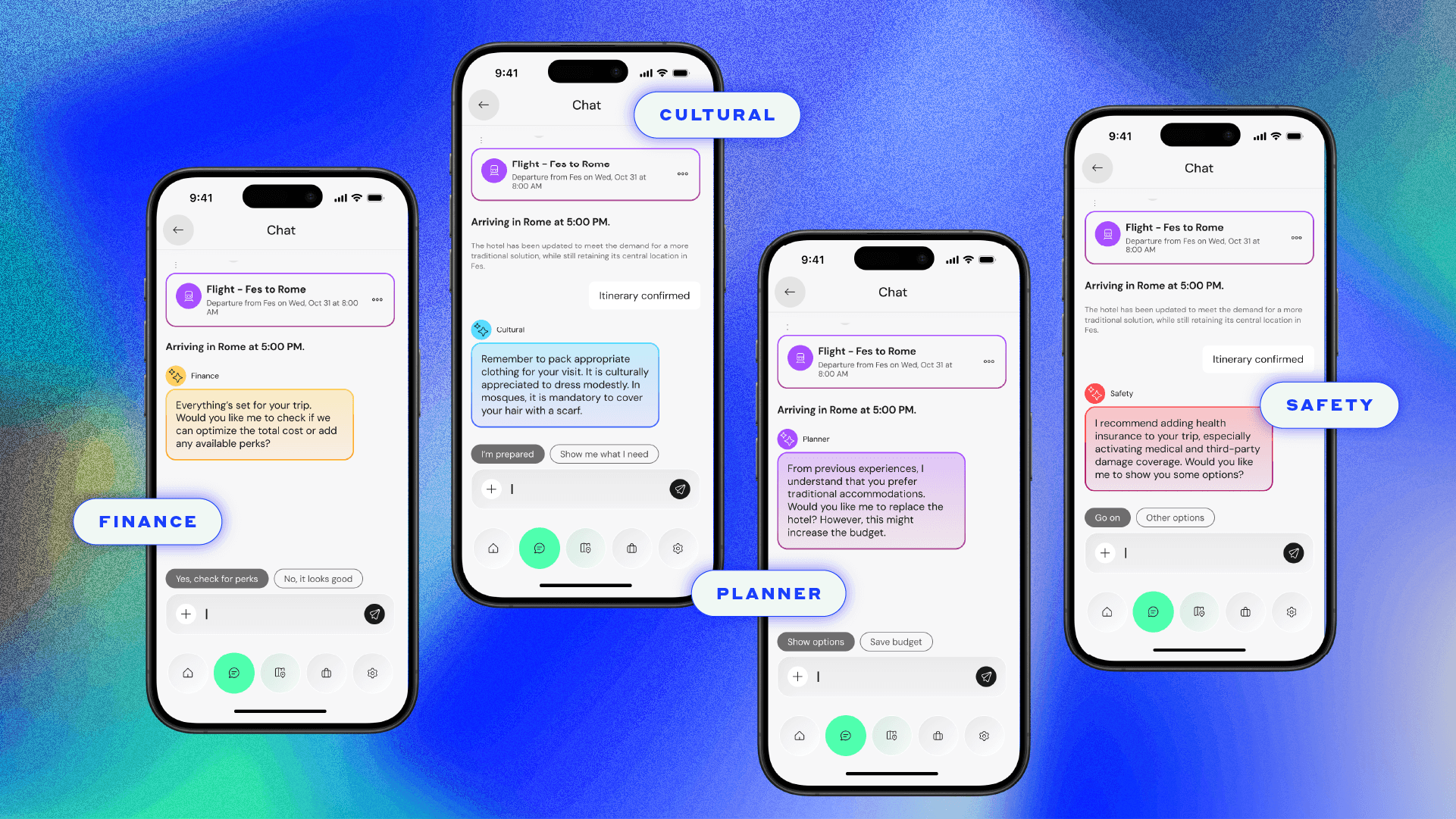
At the heart of our approach are specialized “voices” that work together to support the user in planning and managing the trip: Planner (itinerary, lodging, transportation, experiences), Cultural (local life, norms, and etiquette), Safety (health, insurance, visas), and Finance (budget, partner deals, benefits). They are not generic chatbots. Each is an AI agent with its own role, tone of voice, and degree of initiative, drawing on the user’s preferences to personalize every suggestion.
Each voice steps in at the right moment, with the right tone, creating an orchestrated experience that is never intrusive. The balance among the voices decides how often and in what way each one speaks up, adapting to the user’s needs at every stage of the trip. The voices work together in the same conversation, each bringing a different perspective to the decision. The result is not a single answer but a dialogue that helps users understand, compare, and choose. Complexity stays in the background, never concealed. Users can step in, make changes, and ask for explanations.
From input to prototype: the method we built
Designing an AI-native product means evolving the traditional design process. It is no longer only about designing interfaces, but about orchestrating multi-agent architectures, defining intelligent behaviors, balancing standard AI components with proprietary features.
Using the travel app as our test case, we built and tested a framework that shifts the focus of design. The work moves from defining screens to designing multi‑agent architectures, where several specialized AI agents work together.
The process begins by asking whether and how AI can expand what the product can do. The customer journey is then reframed as a set of loops and connections, not a rigid sequence.
Features then follow from the role AI plays for the user, whether that is automating, assisting, augmenting human capabilities, or guiding decisions. At the center of the system sits the human‑in‑the‑loop, a cycle of input, processing, output, and continuous feedback.
The prototype is therefore not only a way to validate the interface. It tests how the system behaves over time.
The building blocks of AI-native products
What we learned designing this experience goes beyond travel. We identified a set of building blocks, the core elements that define AI-native products and can be applied in different contexts.
Multiple access points and non-linear Customer Journey
AI-native products move beyond predetermined journeys in favor of dynamic experiences, where users can take unpredictable paths depending on their intent or need. The key question is which entry points our experience should offer, given the customer’s level of awareness.
From pages to intentions
Users no longer translate a desire into filters and parameters. They hand over a goal and expect a result. The interface is no longer designed screen by screen, but composed according to intent. For this reason the Design System changes role. It is no longer just a tool that keeps designers visually consistent. It is the set of instructions AI follows to assemble components, content, and tone in line with the brand’s rules. If those rules are not encoded in a form the machine can understand, the experience it generates will be inconsistent.
Multi-factor decisions with adjustable drivers
Decisions are supported by different lenses, such as cultural, financial, and logistical factors, that are not fixed but adapt to the user’s needs and interests in the moment.
Progressive knowledge and visible profiling
In an AI-native product, personalization is not a side effect but a deliberate choice. What the product knows about the user builds up gradually and stays visible. Profiling is no longer limited to an initial set of questions, but updates dynamically based on interactions and reactions to the proposed content. Preferences, patterns, and data can be viewed, confirmed, or modified. AI explains what its suggestions are based on and how information is used. This level of transparency is essential to build trust and make the user an active part of the experience.
Hidden complexity and new comparison patterns
Choosing no longer means scrolling through long catalogs with standard filters. Users see a few relevant options and shape them by confirming or replacing what the AI proposes. Comparing options also moves beyond traditional formats, with new navigation layouts such as multiple views, voice mode, and dynamic switches.
Augmented discovery
Moments of inspiration are enhanced by new channels and formats, which the brand does not necessarily control but integrates ethically and transparently.
Integrated benefits
The experience lets users purchase connected services from different providers in a single flow. It anticipates relevant add-on services, avoids overlaps between them, and factors in the benefits and partner deals the user already has.
Dynamic updates and assistance
The digital product detects the unexpected and updates the experience accordingly, seizing new opportunities or resolving emerging issues.
Agents as users
People are no longer the only ones using the experience. AI assistants and agents browse, compare, and, increasingly often, act on behalf of the user. Content, data, and services must therefore be structured, reliable, and readable by machines as well, with clear rules on what an agent can see, propose, and do. We now design for two audiences, the person and their agent, who rely on the same content and the same trust.
Scalability of the solution
The building blocks we identified are not specific to travel. They apply to any context with similar dynamics, from luxury, beauty, and design, where catalogs are too large to compare, to pharma, life sciences, and energy, where offers extend beyond the core business. They also fit financial services, where customers buy several solutions together, and telco, media, and services, where conditions change in real time.
The technical solution we prototyped, a modular AI-native architecture based on an intelligent orchestrator, a multi-agent system, and an integrated data layer, shows that we can build scalable, reliable experiences that respect user privacy, combine AI models with proprietary logic, and keep humans in control.
What we take away
Designers are moving from shaping things to orchestrating them, and their role matters more than ever. The core skills stay the same, whether it is observing people, writing, or building coherent systems. What changes is where they apply, which now includes data, hypotheses, and the rules that govern how agents behave.
Our method hasn’t changed so much as expanded. When the interface is generated from intent, we stop delivering finished products and start delivering living systems. The real value doesn’t come from adding AI to what already exists. It comes from starting with the user and asking what’s possible now that wasn’t before.
That question will shape the next generation of digital products. As a crew, we have only just begun to explore it.