Attention as a form of foresight
Beyond the next word, towards the next world
by Ryslaine Moulay and Luca Morena
How do you predict what a trend will mean, and for whom, before the group that will hold it has even formed?
Imagine a venture fund backing “raw” food brands in 2016 on the strength of wellness trend data. The bet pays off. By 2025, the same signal points toward raw milk brands which have become, in the intervening years, a libertarian political statement and a contestation of federal food safety authority. The data were continuous. The world it described had fractured. Ontology failed.
Every predictive practice rests on an assumption about what kind of object it is tracking, and contemporary foresight, for the most part, tracks objects as though their meaning were included in their extension. It is not.
The prediction machine of the moment, the large language model, works by guessing the next word in a sequence, and we have quietly let “guess the next word” stand in for guessing the future. A sentence runs on rails. Meaning jumps tracks, it changes sign, doubles back, gets seized by people who despise each other. Wiring the two together is the error now built into most forecasting methodologies.
What we propose is an ontology of adhesion to the world: a regime of attention to the forces that compose the real before the data registers them.
Adhesion is staying with a word as it moves: following the gesture it performs, what it sets itself against, and the actors who carry it, across the years it takes a meaning to form.
The aim is concrete: to name the next configuration of a word before the group that will hold it has formed, what the word will mean, and for whom.
What follows is applied research. We chose one word and tracked it: 278 outcomes from the Nextatlas early-adopter platform, and a parallel archive bookmarked by hand since 2012. We selected philosophical frameworks from existing scholarship and put them to work on the data. Frege and Bennett to build the analytical framework, Latour and Deleuze to make the cartography operable.
AXIS 1
What are we predicting, exactly?
Every ontology of foresight turns on a distinction that common sense collapses, and that Frege, in 1892, kept apart. The morning star and the evening star refer to the same object, Venus. The extension is identical. Yet the two names do not mean the same thing. They carry different descriptions, different positions in the sky, different uses of language. Discovering they referred to the same planet did not alter Venus. It reconfigured the relationship between sense and reference. Material reality stayed put. Meaning shifted.
Contemporary foresight confuses these two planes systematically. When a report declares “raw will go mainstream,” it is predicting something extensionally precise: the spread of uncooked ingredients, unpasteurised milk, unfinished surfaces. A plausible claim, verifiable after the fact, and largely trivial. But the signal being observed is not only the materiality. It is also, and above all, the signifier “raw,” crossing incompatible semantic territories. The material object is stable. The meaning is not.
A recent episode makes the problem concrete. December 2025: Time named its Person of the Year the “Architects of AI,” a collective formulation rather than an individual. On Polymarket and Kalshi, the two largest prediction markets in the world, tens of millions of dollars had been wagered on the outcome. Faced with the same public announcement, the two platforms resolved bets in opposite directions. One paid out to those who had backed individual executives. The other paid out those who had backed “AI” as a category. No informational asymmetry, no probabilistic disagreement. Everyone knew what Time had published. What fractured was something more fundamental: what, exactly, had happened.
The episode was read as a flaw in arbitration. It was something older. Bennett, in Events and Their Names (1988), had already fixed the point. Events are picked out by descriptions, and different descriptions can pick out different events from the same physical occurrence. The same Time cover was, under one description, the choice of an individual, and under another, the recognition of a category. The platforms were arbitrating two different events with the same announcement underneath. Their ontology is procedural, not physical. Prediction markets behave as if events were extensional objects with neat boundaries waiting to be realised. But many of the things they trade on, elections, awards, regulatory decisions, are social facts.
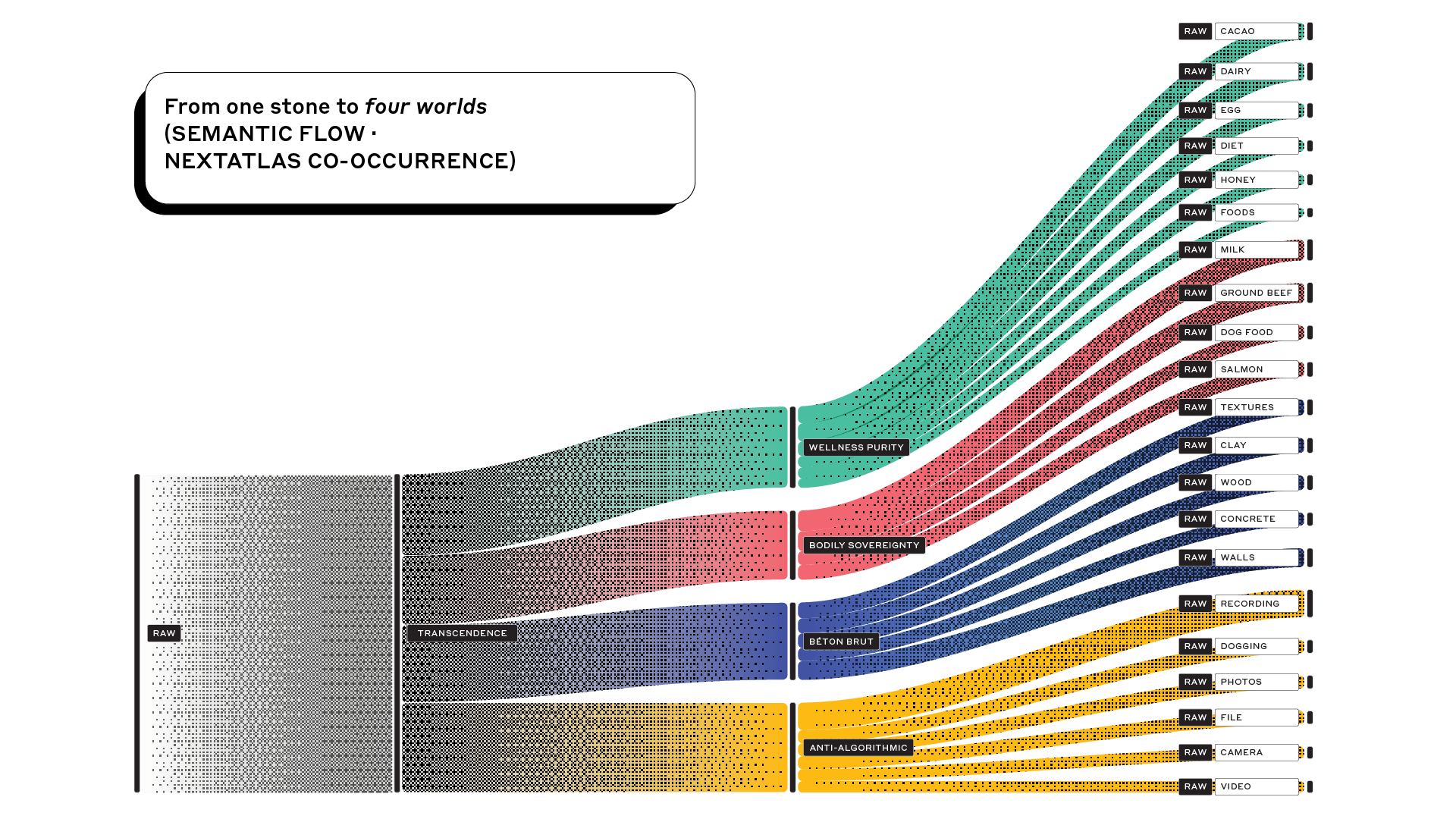
Read left to right. The material substrate — unpasteurised, unprocessed, uncooked — enters as a single node. It passes through a single shared operation, transcendence, the largest need “raw” serves in Nextatlas data. On the other side it splits into four frames, each carrying the same gesture toward a different target. Each frame terminates in the specific referents early adopters actually use. Band thickness reflects Nextatlas co-occurrence strength.
The question becomes philosophical. When a foresight instrument says “raw is growing,” what is it measuring? The material spread of a property, indifferent to meaning? Or the migration of a signifier across networks of actors, conflicts of legitimacy, opposed institutions? The two predictions share a syntactic form and have no semantic overlap. One is almost always true and almost always trivial. The other is the real object of foresight.
Quantitative data on its own cannot distinguish between them. When meaning moves, when the category is renamed, transits toward opposed networks of actors, acquires a different cultural authority, we go on believing we are predicting the object. We are losing the meaning. And meaning does not follow extensional laws. Catching that movement requires a different posture from the analyst, closer to attention than to prediction. Meanings do not only configure across space. They reconfigure over time, at rhythms linear prediction cannot capture. What changes is the underlying operation a signifier is performing, and the enemies it is defining itself against. It is this structure that data can make visible, if the instrument is built to look for it. That structure has two components — the operation a signifier performs, and the field of refusals it generates and both are measurable.
AXIS 2
What keeps a signifier in motion?
A decade of early-adopter intelligence on “raw” returns 278 outcomes across nine industries, with no single category owner. The single largest need-state it serves is transcendence, at 15.5% of signal. To eat raw, to keep a raw-milk cow, to expose the raw beam, to post unfiltered photographs: each is an exit gesture, a refusal of a specific mediation. The frames disagree on what to transcend. The operation is shared.
Each new form of mediation worth refusing generates a new grammar of rawness, and the material substrate (unpasteurised, unprocessed, uncooked) stays stable enough to receive it. The more extensionally stable an object, the wider the range of moral configurations it can carry. A referent that holds still is what makes intensional capture possible, and lets it happen again and again.
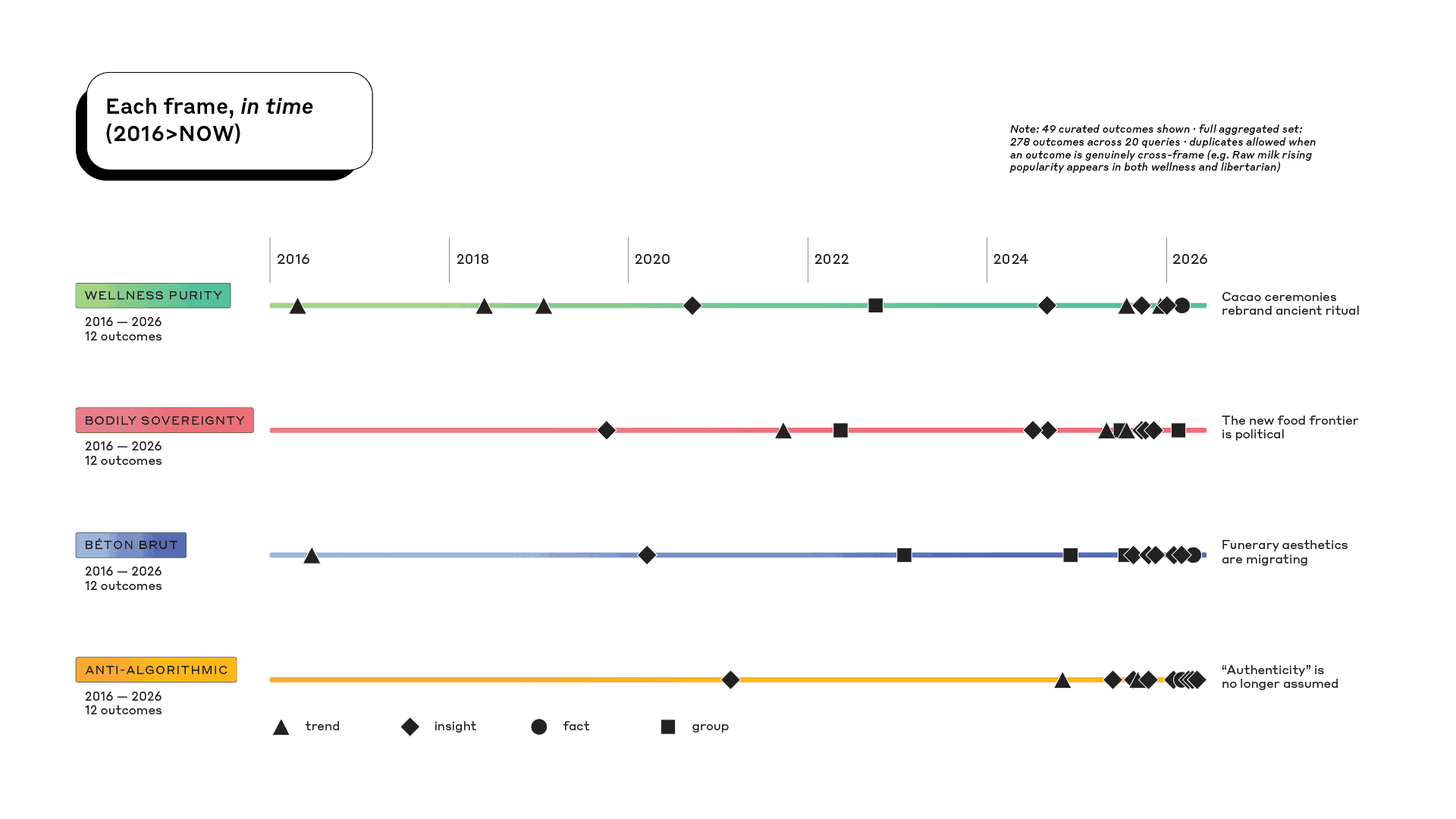
Each marker is a Nextatlas-published outcome. Brutalist food (2018) is the early cross-frame bleed: wellness and design were already in contact eight years ago. Radical Rawness (February 2026) is the moment four decade-long lineages got consolidated into a single named object.
The range of incompatible configurations “raw” has absorbed makes this concrete. The wellness industry produces raw cacao and raw dairy as exits from industrial processing. The libertarian constellation produces raw milk as an exit from the regulatory state. Design culture produces raw concrete and visible seams as exits from finish and polish. Anti-algorithmic culture produces raw dogging and photo dumps as exits from platform curation. Their politics are opposed. A signifier that serves opposed moral universes through a single shared operation is structurally promiscuous, and the data can measure how much.
Attention to the refusal field is what makes that movement visible before the spread catches up. Each configuration of “raw” orients itself against a specific term: Pasteurised is collapsing: -33% past, -28.5% forecast, the lexical battle has been conceded. The algorithm peaked out loud and is quieting: +44.1% past, -36.4% forecast, becoming ambient infrastructure, harder to name and therefore harder to refuse. Polished is exploding: +77% past, +34.5% forecast. Béton brut has the most traction of the four frames at this moment, and the refusal field explains why.
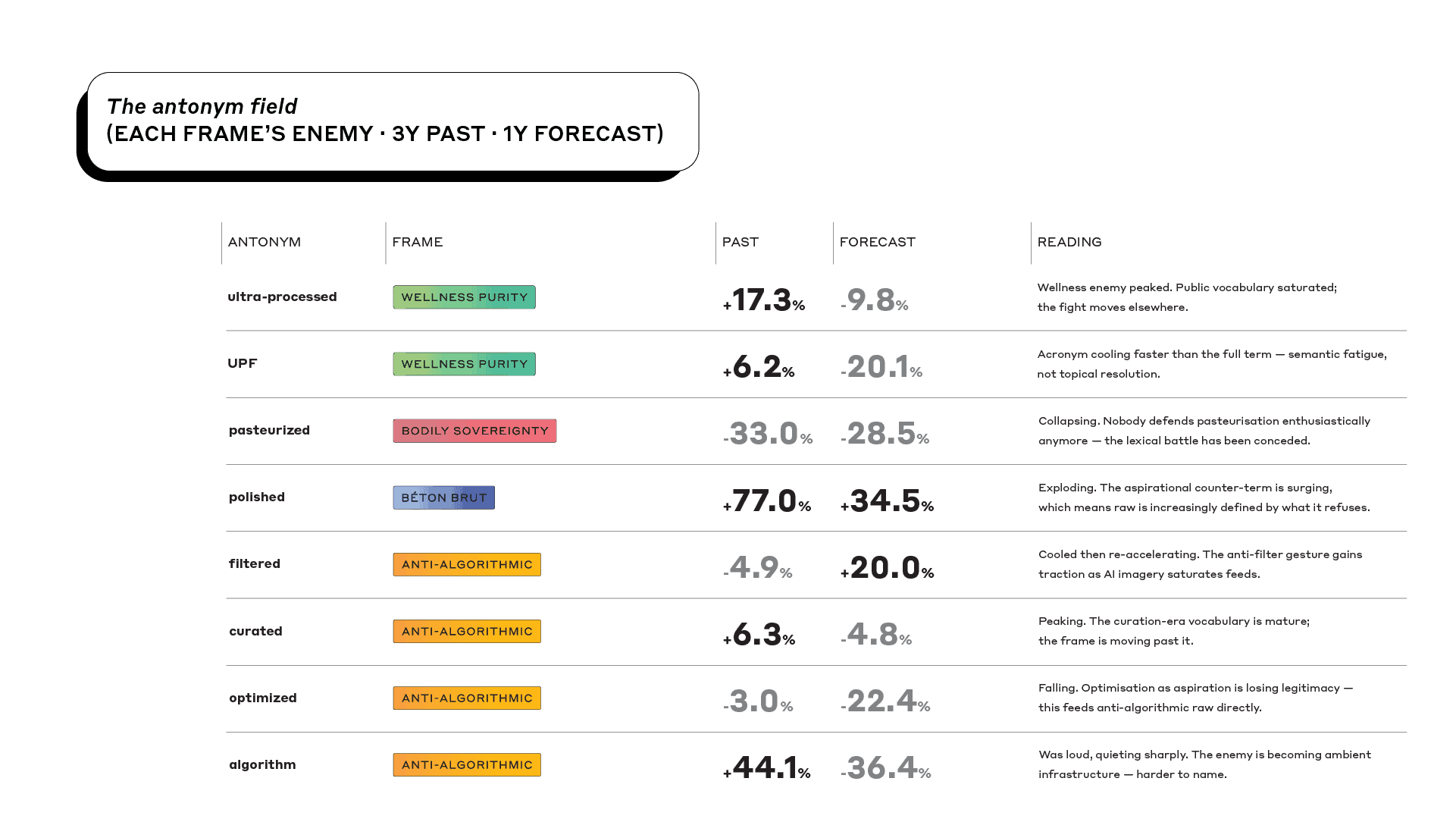
Each frame defines itself against a different enemy — and the enemies are not symmetric. Pasteurised is collapsing. Algorithm is quieting. Polished is exploding. The frame whose enemy loses visibility will lose its own grip on “raw” — a refusal cannot be sustained once its opposite fades from cultural salience.
A frame’s longevity depends on the salience of what it refuses: when the term being pushed against fades from cultural visibility, the configuration loses its grip on the signifier. Together, the shared gesture and the refusal field define what we are calling a semantic configuration: a signifier, the operation it performs and the field of terms it orients itself against. What a semantic configuration cannot show is the network of actors who carry it and in that network, the next displacement is already forming.
Axis 3
For whom? The network of recognition
Meaning composes and decomposes. What it doesn’t show, on its own, is through whom. To answer that, we turn to the relations between the actors who carry it.
Mapped out, the configuration of “raw” is not made of people and institutions alone.
For example, the American libertarian movement turned a scientific claim about the microbiome into a political argument against federal regulation: raw milk’s living bacteria became proof that the body knows better than the institutions that would pasteurise it. The microbe carries the politics, and a microbe is harder to dismiss than an opinion. Anything that makes a difference this way, human or not, is what Latour calls an actant, and the configuration of “raw” is built from them: microbiomes, TikTok’s recommendation systems that decide which captures reach critical mass, the FDA’s frameworks that determine what can circulate as “raw.”
Meaning is produced by the assemblage of these actants, and transforms when the assemblage transforms. Power, in this field of unequal forces, is the capacity to stabilise meaning temporarily, through regimes of legitimation that are distinct and non-interchangeable. Goop and the Weston A. Price Foundation perform the same operation on the same signifier; the configuration in which each is inscribed determines the meaning.
Followed across time, the map shows what a snapshot misses: some actants act as vectors, carrying the raw gesture across frames. Kinfolk, the design magazine, moved it from food culture into material aesthetics; béton brut brought it in from architecture. These crossings don’t show up in co-occurrence data, which only registers what sits next to what at a given moment.
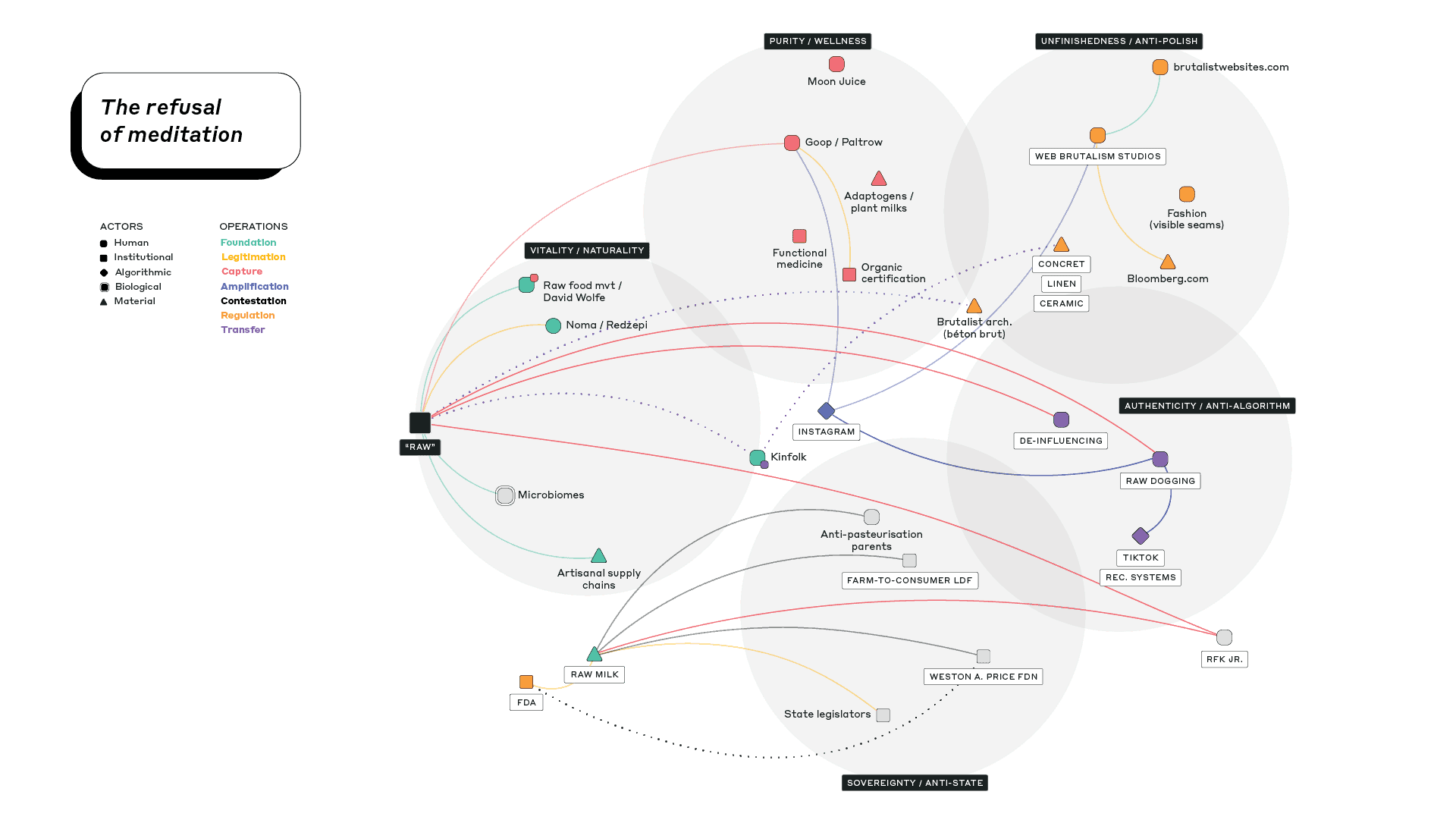
Relational cartography of “raw”, reconstructed from a hand-curated archive of articles collected from 2012 to 2025. Nodes denote actants (human, institutional, algorithmic, biological, material),and edges the operations through which meaning is produced and displaced (foundation, capture, legitimation, contestation, amplification, transfer) Tracked across phases, the cartography renders legible what sector-specific monitoring cannot: the migration of the signifier.
To make that movement visible, we borrow Gilles Deleuze’s distinction between a tracing and a map. A tracing copies categories already drawn: monitor “raw” sector by sector (food, design, ai) and “raw” returns four separate growths. A map has many entry points and follows one signifier wherever it travels across sectors. We built a map, and that is what makes a vector visible at all: a gesture moving between fields before either field shows it.
Where actants converge without knowing it, as libertarian food culture and anti-algorithmic rawness did around the “trustable food” cluster in 2025, semantic density accumulates, and that density is where the next capture forms. RFK Jr.’s arrival in phase 5, carrying the libertarian frame into federal policy, registered in co-occurrence data only as a late spike in “raw milk” signal; the relational map had made it structurally predictable two phases earlier.
Conclusion
From prediction to attention
The object of foresight is never where the instrument points. The signifier stays still while the configuration transforms. The frame consolidates while its enemy quietly dissolves. The assemblage shifts and meaning recomposes somewhere the data hasn’t caught up to yet.
Two candidates are currently forming for the next grammar of rawness. The test in both cases is the same one that identifies the four established frames: a rising vocabulary of refusal and a rising vocabulary of affirmation, moving together. “Unregulated feeling,” raw as emotion refusing the self-management script, passes both: the language of self-management is re-accelerating (mindfulness, self-help, CBT all in forecast growth), and the counter-vocabulary is at cultural peak (unfiltered, breakdown, emotional intensity at or near 1.00). “Unmonetised,” raw as attention, time, labour before the price, passes one and not the other: the enemy is loud (monetized peaking now, commodified +75% forecast, transactional +122% past three years) but the positive pole has not yet cohered. The cultural pressure is visible; the words for what the frame would consecrate are still missing.
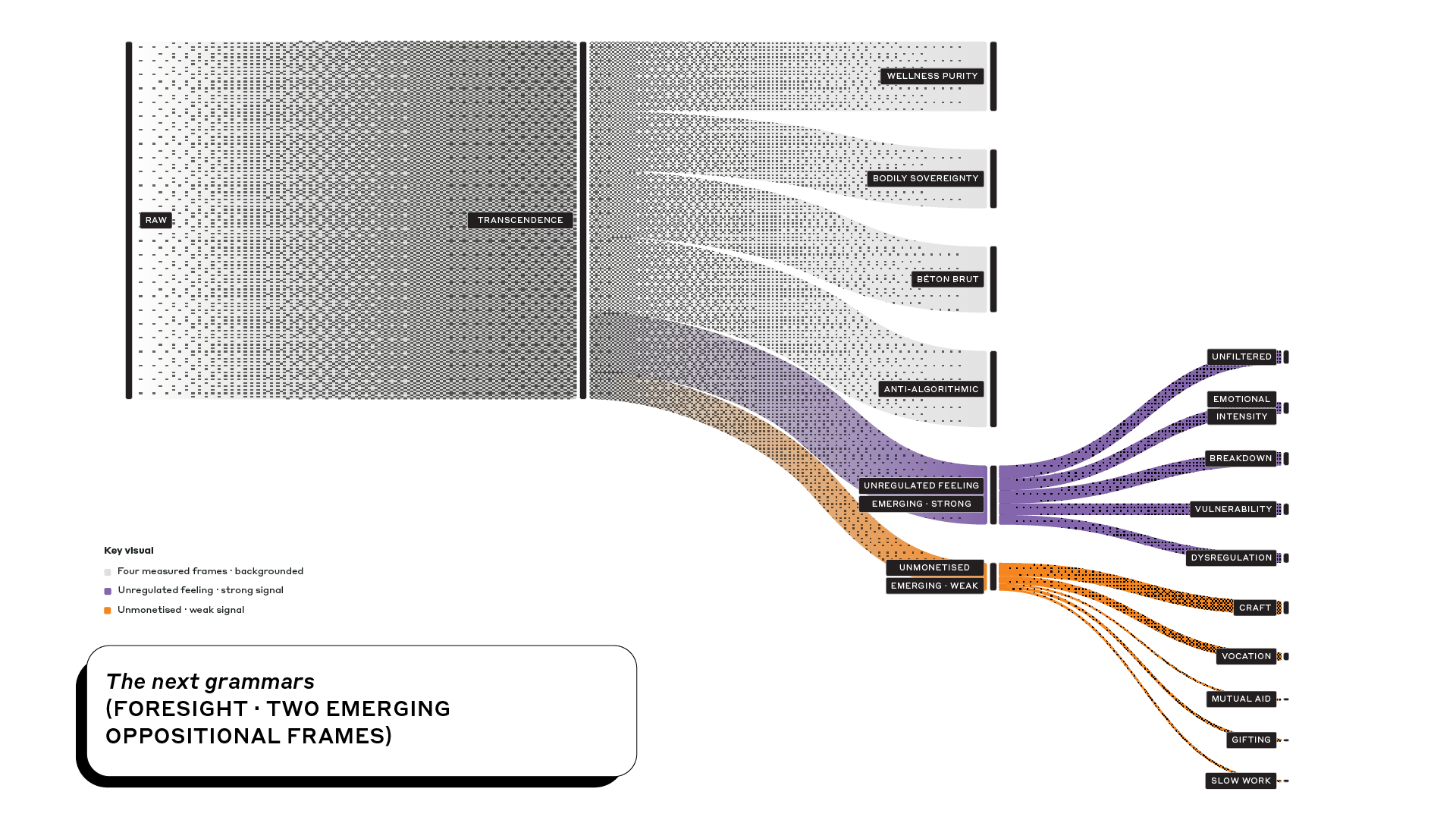
The four measured frames recede into the background. Two emerging candidates come forward: Unregulated feeling (signal strong on both refusal and affirmation) and Unmonetised (refusal strong, affirmation not yet cohered). Band saturation reflects signal strength.
An ontology of adhesion to the world demands a posture of attention: the sustained openness to how meaning composes, holds, and dissolves through time, in the network of actors and refusals that carry it. That is what adhesion requires: an instrument that stays in contact with what it observes, and keeps listening.